
Richland Unclaimed Money Records
Richland Unclaimed Money searches work best when you start with the city finance file and then move to the state portal only after the local source is clear. Richland City Hall at 625 Swift Boulevard is the place where budget, accounting, treasury management, and utility billing records come together, so it is often the office that can explain why a city check, refund, or account balance stopped moving. If the record became police property instead of a money claim, the police records trail is separate and the document type changes completely. That local distinction saves time and prevents the wrong request from going to the wrong office.
Richland Unclaimed Money Basics
The Washington Department of Revenue portal at ucp.dor.wa.gov is the state search site for Richland Unclaimed Money that has already been reported. Washington's current unclaimed property law is in RCW Chapter 63.30, which controls how holders report property after dormancy and how owners later claim it. For Richland residents, the state database is the filing step, but the city records show what the original transaction looked like before it left local custody.
Richland Finance is the department that usually bridges that gap. The city’s finance page describes its work as budget development, accounting and financial reporting, revenue and expenditure tracking, audits and compliance, and treasury management. The department’s contact information places City Hall at 625 Swift Boulevard, Richland, WA 99352, with phone (509) 942-7389 and business hours Monday through Friday, 8:00 a.m. to 5:00 p.m. If your lead is a city refund, vendor payment, or utility balance, this is the right local office to ask before filing the claim.
| State portal | ucp.dor.wa.gov |
|---|---|
| Finance | City of Richland Finance |
| City Hall | 625 Swift Boulevard, Richland, WA 99352 |
| Phone | (509) 942-7389 |
Finance and Treasury
Richland Finance covers the functions that usually sit behind an unclaimed property record: budgeting, accounting, treasury management, and utility billing. That mix matters because the source of a state claim is often not obvious from the database entry alone. A city issued payment can look like an ordinary check, a utility credit, or a vendor reimbursement until Finance shows where it was booked. Richland also keeps budget and finance material online, which is useful when you want to understand whether a transaction came from a routine account, a utility record, or another city fund.
The city’s financial information is especially helpful because Richland emphasizes transparency and planning in its budgeting process. The finance page points to annual reports, budget documents, and related planning material, which tells you the city maintains a structured record trail. That structure makes it easier to trace a payment by amount and date, and it makes it easier to confirm whether the item was already reported to the Department of Revenue after the dormancy period ran out.
If you are trying to reconnect a past check to a current owner, the local finance office should be the first stop. If the item is still in city custody, Finance can usually tell you whether it was voided, reissued, or sent on to Washington. If it has already left the city, the state claim process becomes the next step rather than the first guess.
Richland Unclaimed Money Images
The clearest visual fallback for Richland is the Washington state claim search form. When the city website is not available as a local image source, the state portal image is the best practical reference for how the claim gets matched.
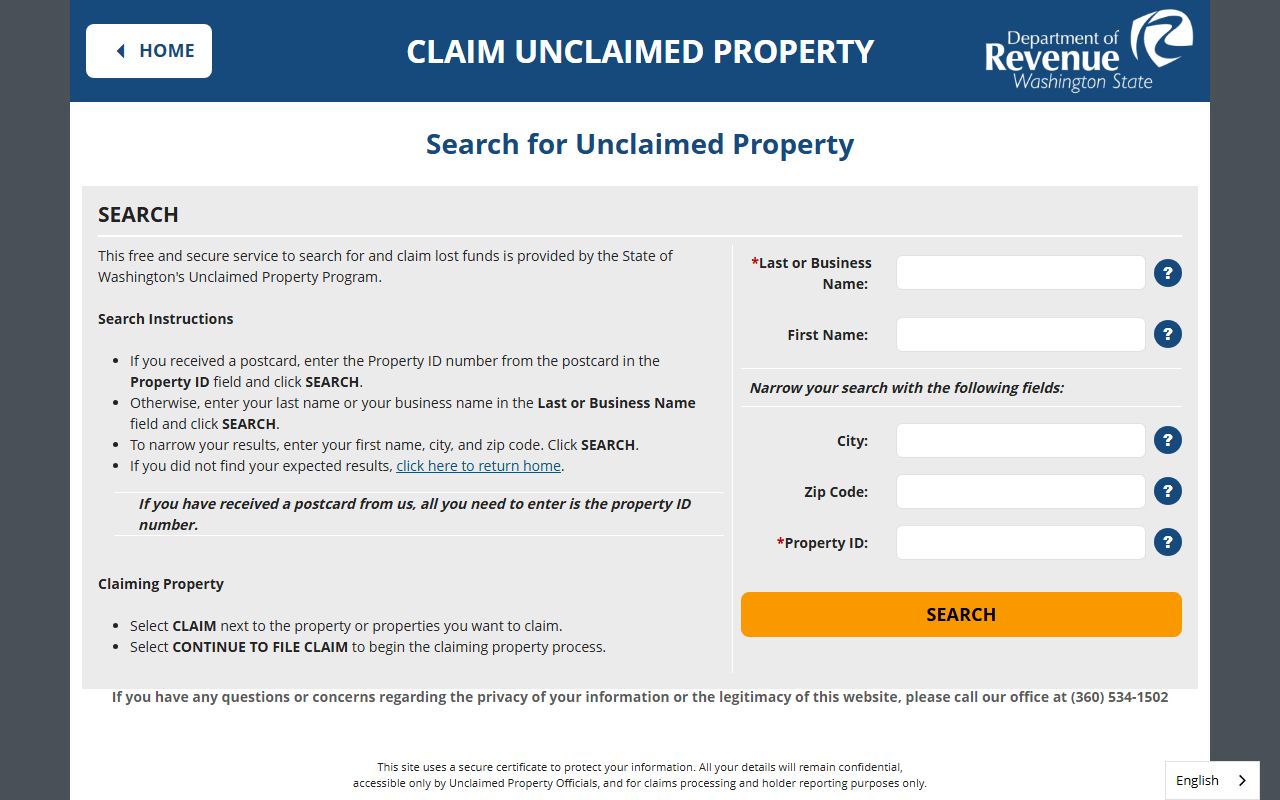
The state form matters because it shows the same search inputs Richland claimants will use if the city record has already been reported. A local finance file explains the source, while the state form explains how the final claim is filed and tracked.
Richland Unclaimed Money Search Steps
Richland Unclaimed Money searches are easiest when you separate the local finance trail from the statewide claim. Start with the Washington search if you have a name or old address, then use the city finance page to understand whether the record was generated by a city check, a utility credit, or another account type. The state search accepts a Property ID when you received a postcard, and it can also be narrowed with city and ZIP code when the name alone is too broad.
- Search the Washington database first to see whether the item has already been reported.
- Use Richland Finance when the clue looks like a city check, utility balance, or treasury item.
- Use the city public records page if you need the document behind the payment trail.
- Check claim status after filing so you can answer quickly if Washington asks for more proof.
The city clerk and public records system are important here because Richland makes many records available online before a formal request is even needed. Use the Public Records page when you need a formal request path, and use the Municipal Code & Ordinances page when the payment or fee is tied to a local rule. If the record is one of those items, you can often confirm it without waiting on a broad records search. That keeps the claim file cleaner and makes the ownership trail easier to show.
Police Property and Richland Unclaimed Money
Richland police records are separate from ordinary money claims. The city’s Police Records team manages official police information and stolen property records, and the department’s public records pages explain how to request records maintained by police. Richland’s research also notes that police property and evidence items have their own 60-day holding period after case adjudication, which means the item can move through a custody workflow before it is ever treated like a claimable record. That is why the property type matters so much.
For a physical item, the claim path is not the Washington unclaimed property database alone. It is the police property and evidence process, paired with the city’s public records request page if you need the supporting file. That is the right route for a wallet, firearm, found property, or other item that is being held rather than paid out.
If you are dealing with a city check instead of a police-held item, stay in Finance. If you are dealing with property custody, stay with police. The two systems serve different purposes, and Richland’s records make that distinction pretty clear once you know where to look.
Richland Unclaimed Money Claims
Once a Richland record shows up in the state database, the actual claim is filed with Washington. The Department of Revenue expects proof that ties the current claimant to the owner in the record, and that may include an ID, address history, probate documents, or a name-change document. The city file is still useful because it often tells you the source department, the amount, and the issue date. Those details help you avoid guessing when the state asks for proof.
Richland’s public records pages are especially helpful when you need the official document that bridges the gap between the city payment and the state claim. The city makes it possible to request general records and police records separately through the Public Records page, which is useful when the claim involves both finance and law-enforcement history. If the local record is clear, the claim usually moves much faster.
For Richland residents, the simplest sequence is to search the state, confirm the city source, gather the proof, and file the claim. That mirrors the way the record actually moved from city custody into Washington’s system and keeps the paperwork aligned with the original transaction.