
Spokane Unclaimed Money Records
Spokane unclaimed money searches usually start with the Washington Department of Revenue, but city records often provide the better clue when the money came from Spokane finance, treasury accounting, or an old municipal payment. The city also publishes notices in the Official Gazette, keeps a police property and evidence facility, and provides public records pathways when there is no public warrant database to browse directly. That means a Spokane search can move in several directions at once, depending on whether you are tracing cash, a warrant, a retained payment, or a physical item held by police. The best starting point is the record type, not just the city name.
Spokane Unclaimed Money Basics
The state portal at ucp.dor.wa.gov is the primary search tool for Spokane unclaimed money, and Washington's current unclaimed property law is in RCW Chapter 63.30. That matters because the Department of Revenue holds property until the rightful owner files a claim, even when the original source was a city payment. If you have a last name, business name, or Property ID from a postcard, the state database is the quickest way to see whether a Spokane item has already been reported.
Spokane's Finance and Treasury office is another key starting point. The department is based at City Hall, 808 W Spokane Falls Blvd, Spokane, WA 99201, and the CFO is Matt Boston. Treasury Accounting can be reached at treasuryaccounting@spokanecity.org, and the CFO can be reached at (509) 625-6585 or mboston@spokanecity.org. That contact set matters when a city-issued check, treasury balance, or local warrant is the source of the missing money.
Spokane Unclaimed Money Images
The Spokane city website is the broadest way to reach local finance, police, and records pages. Visit the Spokane city website when you need the city-side contacts before filing a claim.
That page is the best first stop when you need to confirm which Spokane office owns the record.
The state unclaimed property homepage is the matching statewide reference. Open the Washington unclaimed property portal when you want the claim workflow that applies across the state.
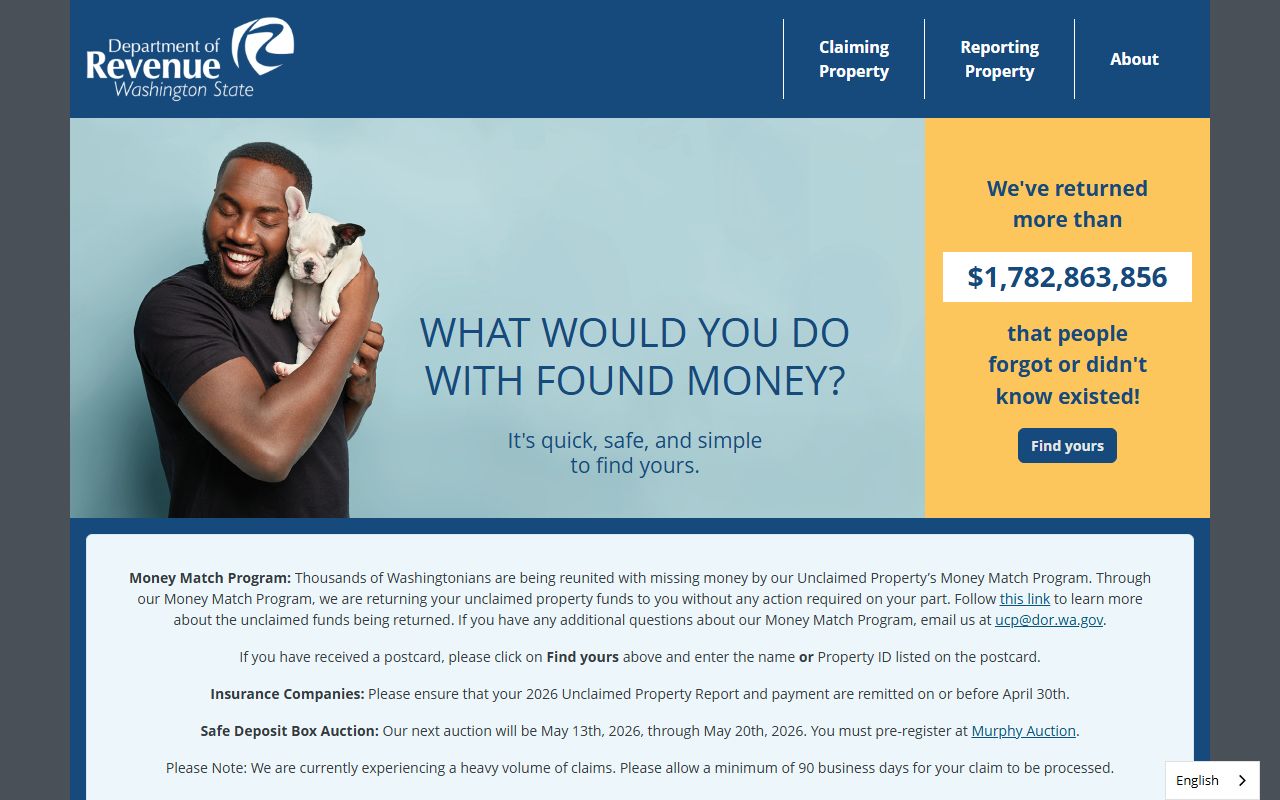
That image gives you the state path that usually finishes the claim after the Spokane record is identified.
Finance And Treasury Records
Spokane's Finance and Treasury team is especially useful because the department handles the city-side accounting trail. Treasury Accounting can tell you whether a payment or balance is still in the city's system, and the Official Gazette publishes claims and warrant information that can point you to the right record. If you know the payee name, amount, or warrant number, those details can lead you from a vague memory to a specific city transaction.
The municipal code page at my.spokanecity.org/city-government/municipal-code/ is the right source if you want to see how Spokane organizes its local rules. In a money search, the code matters because it tells you whether the issue is a city finance problem, a records issue, or a property disposition matter. The city does not maintain a public warrant database, so public records requests are the safer route when you need the underlying document rather than a web search result.
That lack of a public warrant database is important. It means many Spokane searches begin with a clue in a notice, a finance email, or a records request rather than a self-service lookup. The city then becomes a records and confirmation step, while the state portal becomes the claim step.
Spokane Unclaimed Money Search Steps
A Spokane unclaimed money search is usually a two-part process. First, check whether the state database already has the money. Second, use city records to confirm the source if the item came from Spokane Finance, the treasury office, or a police property matter. Because the city publishes warrant and claim information through the Official Gazette rather than a public warrant database, the local paper trail matters more than a quick online search when you are trying to identify a specific item.
If your clue is a warrant or a payment, ask for the date, amount, and payee name. If your clue is a property issue, ask for the case or property number. If your clue is a state postcard, use the Property ID directly in the state portal. The smaller the record set, the easier it is to tell whether you are looking at a real match or a similar-sounding record from another Spokane resident or business.
Washington's claim workflow is straightforward once the record is identified: search, confirm, file, and then track the claim status. The hard part is often just knowing whether the record came from a city department or the state holder system.
Police Property And Evidence
Spokane Police Property & Evidence is a separate path from ordinary unclaimed money. The facility is located at 4010 E. Alki Ave, Spokane, WA 99202, and it is open Monday, Wednesday, and Friday from 9:30 AM to 12:00 PM and 1:00 PM to 4:30 PM. The phone number is (509) 625-4130. That office is the right contact when the missing item is evidence, found property, or another physical asset that was taken into custody rather than money that was reported to the state. The police property route follows RCW 63.32.010.
The city's recover property page at my.spokanecity.org/police/get-help/recover-property/ is the best starting point for that process. Spokane also posts auction notices in the Official Gazette archive, and the city notes that auctions may be handled through an external auction site. If a property item has already been noticed for sale or disposition, the public notice is often the more useful record than the state claim database.
For police property, the question is not usually whether the item is “unclaimed money” but whether it has been properly noticed and released. That makes RCW 63.32 and the city property process the relevant rules rather than the state money claim rules.
Spokane Unclaimed Money Records
Spokane records are most useful when they identify the office and the property type. A city finance record points you toward the treasury office. A warrant notice points you toward the Official Gazette or a records request. A property evidence file points you toward the police property facility. Once you have the right category, the rest of the process is mostly administrative.
For a claimant, the key is to avoid mixing up the city paperwork and the state claim. Spokane may have the source record, while Washington holds the money once it has been reported. That means a single search result may only be the first half of the job. Keep the city information handy, because it often explains why the state record exists and what proof you will need to finish the claim.
Spokane residents and businesses who are not sure where to begin should start with the city website, then move to the state portal if the city record looks like a reportable payment. That sequence keeps the claim path clear and helps avoid unnecessary back-and-forth with multiple offices.