
King County Unclaimed Money Records
King County unclaimed money can begin with a state-held account, a county warrant, or property that was never picked up after a payment, refund, or enforcement action. The county seat is Seattle, and that makes King County one of the busiest places in Washington for people trying to reconnect with funds or documents that were set aside and later reported. Start with the Washington Department of Revenue database, then move to county treasury resources if you are looking for a local warrant or a payment trail. A good search often depends on small details, so names, prior addresses, and agency references matter.
King County Unclaimed Money Search
The first place to check is the Washington State Department of Revenue unclaimed property portal at ucp.dor.wa.gov. The state program is the custodian for unclaimed money in Washington, and it keeps property until the rightful owner or heir comes forward. You can search by last name or business name, narrow results with a first name, city, or zip code, and use a Property ID if a postcard was mailed to you. That makes the state site the broadest search tool for King County residents because it covers bank accounts, uncashed checks, insurance proceeds, utility refunds, and other reported property from many holders.
King County residents should also use the county treasurer resources when the money may be tied to a local warrant or another county payment. The treasurer page at kingcounty.gov/en/dept/treasurer and the tax lookup tool at blue.kingcounty.com/Treasurer/TaxLookup/ help confirm whether the county has a payment history, tax connection, or source record that explains why a check was issued and later marked unclaimed. That extra detail can be useful when you already know the issuing office but do not yet know the claim path.
If your search result looks close but not exact, use the state claim search at the claim search page and the claim status page at claim status search together. The status page helps you see whether a claim is pending, approved, or waiting on more documents. That matters in King County because some owners end up with both a state record and a county record for the same general name or address history, especially after a move, a name change, or a business closure.
Washington Unclaimed Money Help
The Washington Department of Revenue explains the program in plain language at dor.wa.gov/about/unclaimed-property-ucp, including who reports property, how claims are filed, and why the state holds property until an owner steps forward. The state site also links to the FAQ, the claim form, and the “what is unclaimed property” explanation, so it is the best place to confirm how the process works before you submit anything to a county office.
Washington also uses the Money Match program to return some property automatically when records line up. That does not replace a search, but it does mean a King County owner might receive a notice even if they never file a claim first. If you received a postcard or email from the state, keep the Property ID handy, because that number can speed up your search and help you reach the correct account faster than a name-only search.
For a visual reference, the state’s unclaimed property homepage at Washington State Unclaimed Property shows the central search workflow used across Washington.
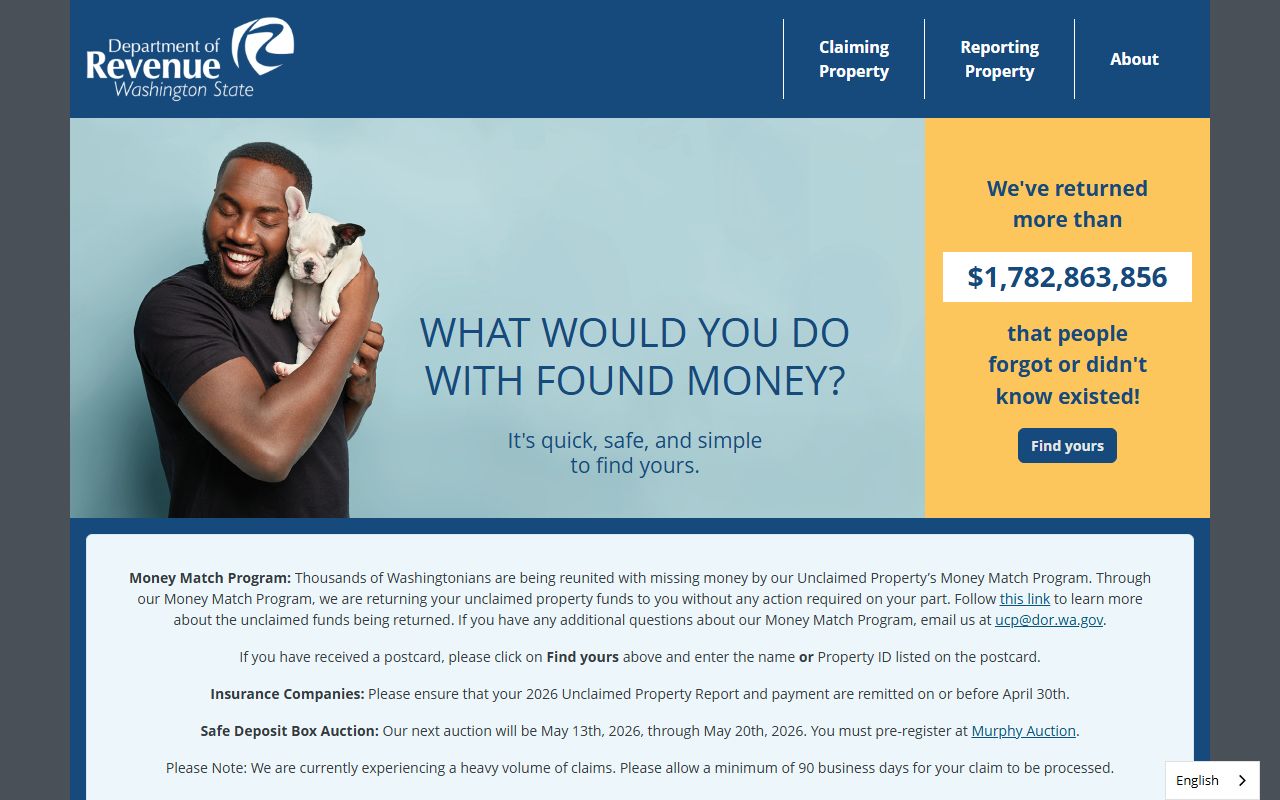
King County owners usually start here because the state database is the broadest way to find reported property before moving into county-specific records.
King County Unclaimed Money Claims
When a result matches, the claim package usually needs a government-issued photo ID, proof of Social Security number, proof of current address, and supporting documents that connect you to the property. King County research also points to the county treasurer as the office to contact for county warrants, and the procedure can include a claim form plus any affidavits or verification the office asks for. The county guidance says claims over $1,000 require notarization, so large payments need a little extra preparation before they are sent in.
The county process is not instant. King County research says processing generally takes 10 to 15 business days once the claim is complete, but incomplete files usually take longer because staff have to ask for more information. That is why it helps to compare the name on the record, the last known address, the issue date, and the department source before you submit anything. A careful submission reduces back-and-forth and helps the treasurer or claims staff understand which record belongs to you.
If you are claiming on behalf of an estate, a deceased owner, or another person who cannot file independently, the state FAQ allows heirs and personal representatives to claim property when they can document their authority. King County claimants should use the same principle locally: prove the relationship, prove the address history when possible, and add any court documents, estate papers, or name-change records that connect the claimant to the original owner.
What King County Unclaimed Money Records Show
King County records are useful because they identify more than just an amount. The research notes that the record may show the payee name, the last known address, the warrant number, the issue date, the amount in dollars, the department or agency source, the date the item was marked unclaimed, and the current claim status. That combination tells you whether you are looking at a county payment, a state-held asset, or a record tied to another public office. It also helps you decide which office should answer questions first.
That detail matters when you are matching old records to a new identity. A name change, a move out of state, or a long gap in activity can make a file look unfamiliar even when it belongs to you. The state FAQ says marriage certificates, divorce decrees, and court orders can help prove a name change, and bank statements, utility bills, or tax records can help show an older address. In practice, the more the record and your paperwork line up, the easier it is for a reviewer to approve the claim without extra requests.
These details also tell you whether the record came from ordinary unclaimed property or from another county process such as a warrant. King County Code Title 4A and the cited RCWs are the background rules that support those local records, but the most useful day-to-day clue is still the source line on the file itself. If the source says a county department issued the item, you are probably better off confirming it with the treasurer before you file a state claim.
King County Sheriff Property And Records
Some claims are about physical property rather than money. In King County, the Sheriff’s Office handles evidence and found property at kingcounty.gov/en/dept/sheriff/services/property, and the local contact details show the office at 516 3rd Ave, W-116, Seattle, WA 98104 with a phone number of (206) 263-2200. The evidence line is (206) 263-2130 and the found property line is (206) 263-2140. Hours are Monday through Friday, 8:00 AM to 4:30 PM. If your search leads to a wallet, keys, a device, or another physical item, those contacts are more relevant than the unclaimed property database.
The King County public records request page at kingcounty.gov/en/dept/executive/procurement-business-opportunities/public-records can help if you need a broader paper trail. That can include internal records, agency correspondence, or documents that show when a warrant was issued or when a file moved into an unclaimed status. Public records are not a substitute for a claim, but they can fill in the gaps when you are trying to prove how a payment or item ended up with the county.
County auctions are also part of the picture when the property is physical. If the sheriff has already disposed of an item, the remaining path is usually the paper trail and the underlying claim record, not the item itself. That is why people searching King County unclaimed money should check both the treasurer and the sheriff resources before assuming the money or property is unavailable.
King County Unclaimed Money Support
Washington law references that often come up in these searches include RCW Chapter 63.30, RCW 36.22.100, RCW 11.76.220, and King County Code Title 4A. Those citations matter because they explain how unclaimed property, warrants, and related county financial records are handled. For most owners, though, the practical path is simpler: search the state database, confirm whether the county treasurer has a local warrant record, and then file the claim with the documents that show who you are and why the money belongs to you.
It also helps to keep a short note of what you found: the exact search term, the property ID if one exists, the office name, and the date you checked the status. If you need to return later, that note saves time and makes it easier to compare a new result with the old one. King County residents who are not sure whether the record is state-held or county-held can use the state site first, then ask the treasurer’s office to point them in the right direction.
The county treasurer is Allison Bolson, the office address is 500 4th Ave, Room 600, Seattle, WA 98104, the phone number is (206) 477-3083, the fax is (206) 477-3066, the email is treasurer@kingcounty.gov, and the public hours are Monday through Friday from 8:30 AM to 4:30 PM PT. Those details are the most direct way to reach the office when you already have a possible match and need to confirm the next step.
King County Unclaimed Money Resources
Use the state search at ucp.dor.wa.gov/app/claim-search and the state FAQ at ucp.dor.wa.gov/app/faq-claim if you want the official claim instructions in one place. The state also provides an explanation of the program at ucp.dor.wa.gov/app/what-is-ucp, which is helpful when you are trying to tell the difference between ordinary unclaimed money and a county-specific payment. For local research, the county treasurer and sheriff pages are the strongest starting points.
King County is large enough that many people find a match only after checking more than one source. A former resident may have a state-held property record, a county warrant, and a tax-related entry in the same general search history. If that happens, do not force the records together too quickly. Compare the issue dates, amounts, and agency names first, then decide which office controls the claim. That approach saves time and keeps the paperwork clean.
Once you know where the record came from, the rest is routine: gather identification, prove your current address, attach supporting documents, and send the claim to the right office. For most people, that is the point where King County unclaimed money stops being a mystery and becomes a short paper process with one clear destination.